
CrocoApps case study
Gadgeteer — Windows VR Game Development Case Study
CrocoApps helped a VR game studio build a physics construction game for Windows VR to make hands-on experimentation reliable and accessible in VR.
Project snapshot
| Industry | VR / simulation |
|---|---|
| Platform | Windows VR |
| Genre | VR physics sandbox |
| Scope | VR physics interactions, chain reactions and construction puzzles |
| Status | Published project; see the project links. |
| Links | Project page |
Challenge
An object that is easy to grab on a screen may be difficult to manipulate in VR. Small placement errors can break a chain reaction, while inconsistent reset behavior makes an exercise hard to repeat or assess.
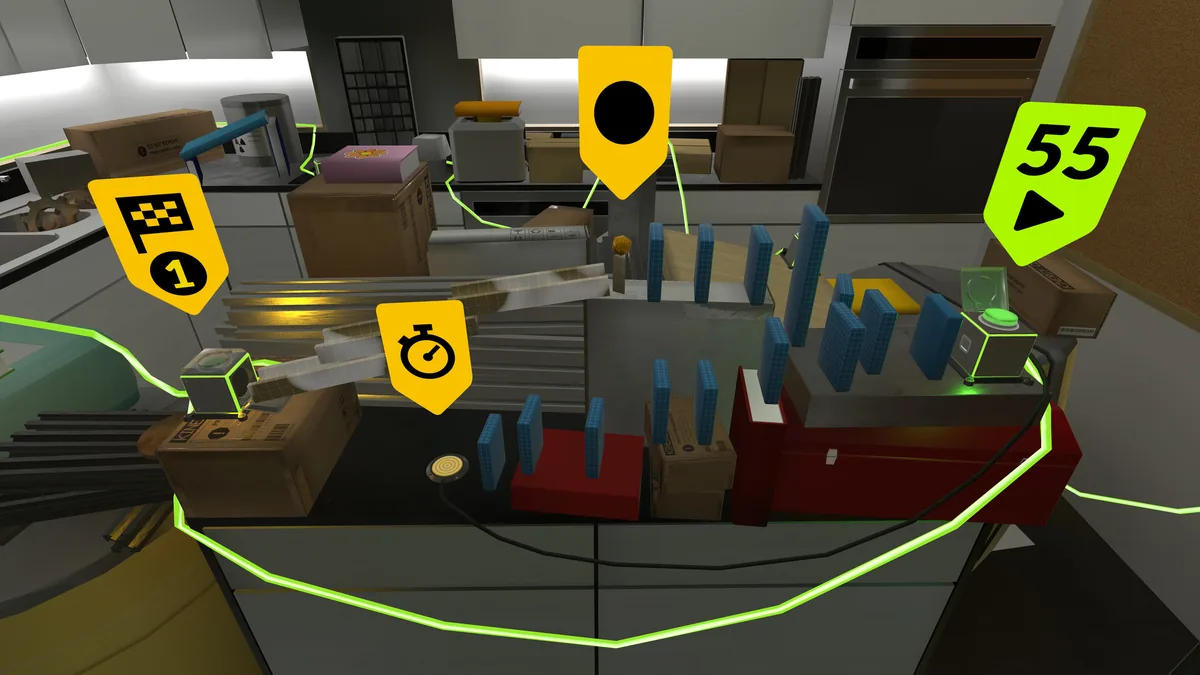
A chain reaction magnifies small placement differences. An object that is slightly rotated or too far from its neighbor can stop the entire sequence, so the player needs both precise manipulation and a clear view of the failure. VR adds the practical questions of reach, viewing angle and recovering a misplaced component.
Solution
CrocoApps focused interaction work on grabbing, component placement and predictable reset behavior. Separating the authored starting arrangement from moving physics objects supports repeatable chain-reaction puzzles.
Gameplay and systems
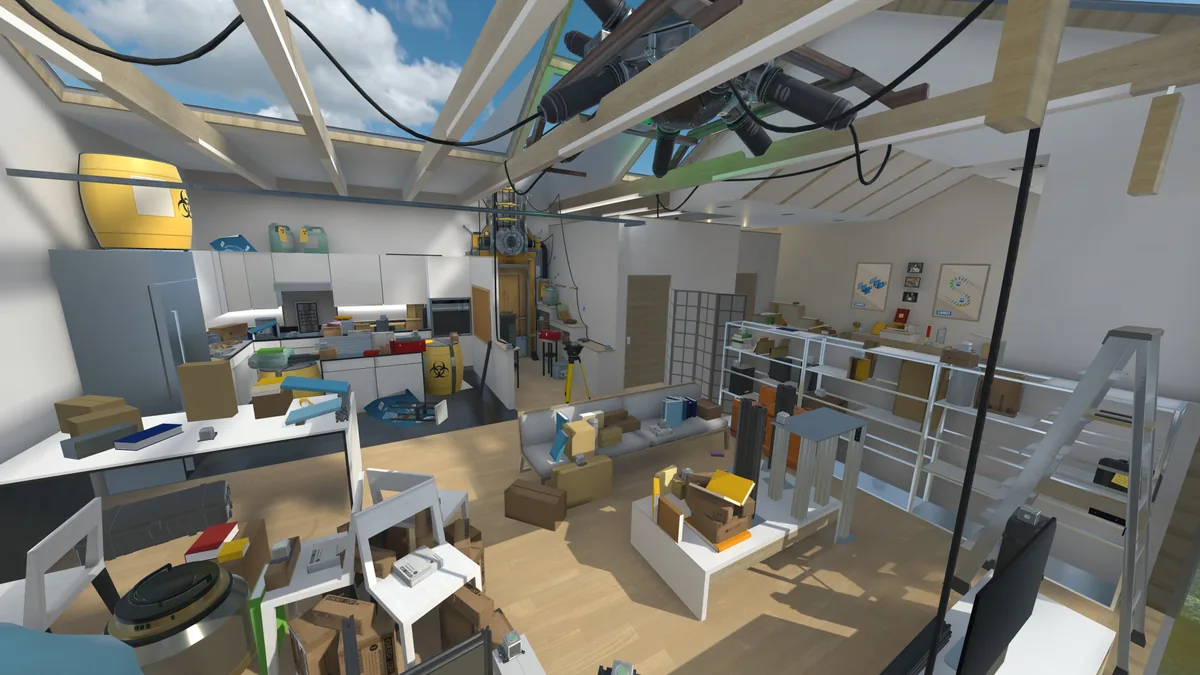
Gadgeteer turns a room into a space for building chain-reaction machines. Components transfer motion through launching, bumping, twisting and turning, so a solution is expressed as a physical sequence rather than a menu choice. The published Steam edition requires VR and tracked controllers and is listed as single-player. Ten supported languages broaden access to instructions while the core problem remains spatial: where to place each object and how it affects the next.
Source: Steam product page. Checked October 27, 2026.
- Core loop
- Place components, trigger a reaction, observe the outcome, reset and adjust the arrangement.
- Progression
- Construction puzzles and sandbox experimentation.
- Multiplayer
- Single-player VR experience.
- Localization
- Ten languages listed on Steam.
Production scope
Interaction work focuses on the complete cycle from grabbing to testing and resetting. A reliable reset preserves the meaning of an experiment: the player can change one part and observe whether the chain behaves differently. Comfortable manipulation keeps attention on the construction problem instead of on repeatedly correcting the controls.
- Game design
- VR physics interactions, chain reactions and construction puzzles.
- Development
- CrocoApps focused interaction work on grabbing, component placement and predictable reset behavior. Separating the authored starting arrangement from moving physics objects supports repeatable chain-reaction puzzles.
- QA
- Test left/right-handed use, dropped controllers, tracking interruption, reach limits and repeated resets. Check that identical setups remain sufficiently reproducible for the intended task.
Project screenshots
Results
Public product figures from the source snapshot checked on October 27, 2026.
- Player reviews
- 97% positive from 94 Steam user reviews in the checked listing.
Source: Steam product page. Checked October 27, 2026.
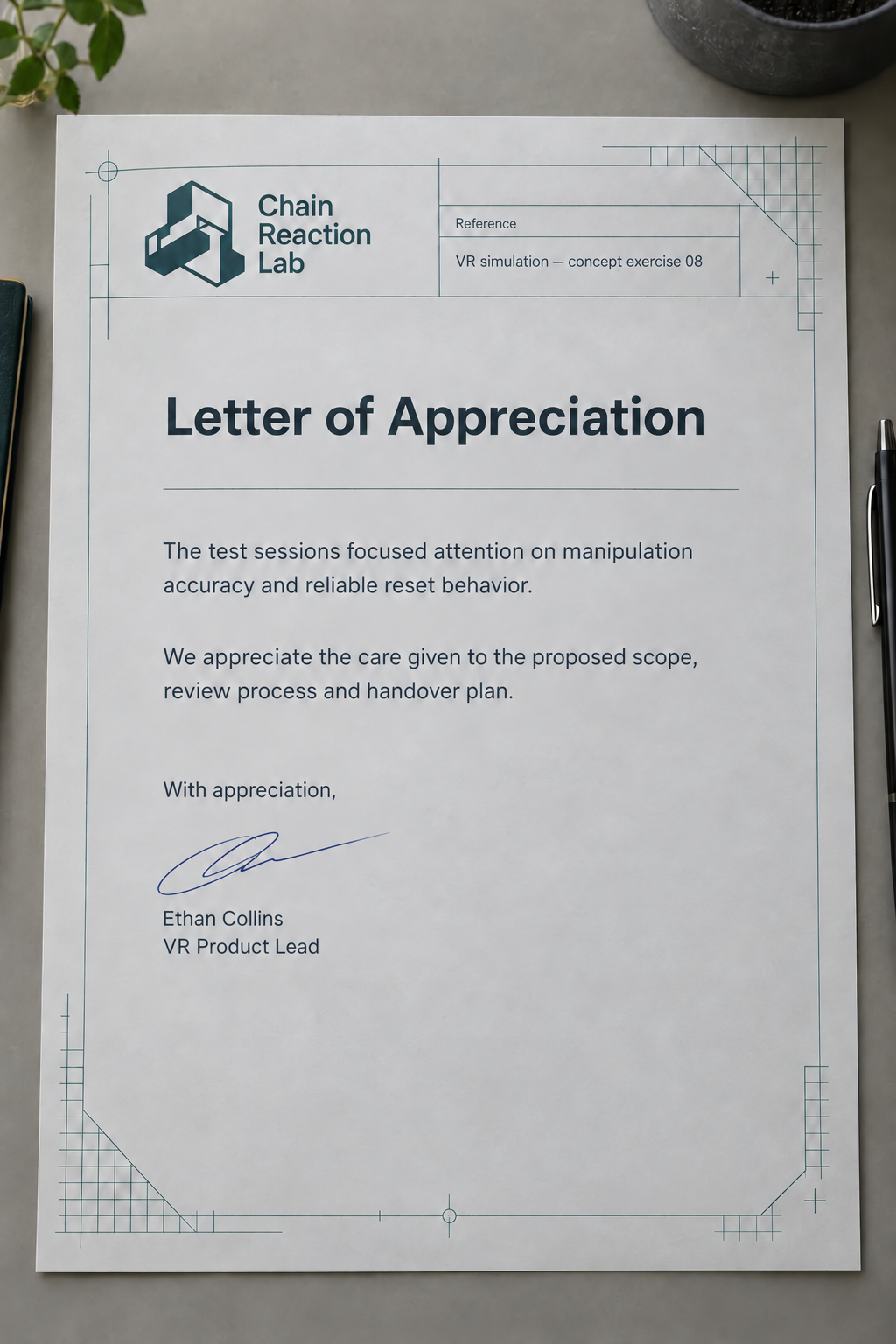
Appreciation letter
Client testimonial
“The most useful reviews let us try the interactions for ourselves. The team paid attention to grabbing, placing and resetting objects, then translated our observations into concrete adjustments. We valued the care given to making the VR controls feel understandable.”

What we learned
Repeatability is a product requirement for a simulation, not merely a convenient debugging feature.
For hands-on VR systems, recovery deserves as much design attention as the initial action. The easier it is to retrieve, reposition and reset an object, the more confidently a player can explore a complicated physical idea.
Build a similar game
Tell us about your audience, target platforms, core gameplay and business goals. We will help define the scope and estimate the work.