
CrocoApps case study
Golf Peaks — iOS / iPadOS Game Development Case Study
CrocoApps helped a mobile game studio build a card-driven puzzle game for iOS / iPadOS to offer readable, compact strategy challenges on touch devices.
Project snapshot
| Industry | Mobile game |
|---|---|
| Platform | iOS / iPadOS |
| Genre | Card-driven puzzle |
| Scope | Card-based puzzle mechanics, terrain rules and mobile level design |
| Status | Published project; see the project links. |
| Links | Project page |
Challenge
The visible action is simple, but movement must remain consistent across terrain, direction changes and card order. A designer needs to know whether an apparent difficulty spike comes from the puzzle or an unclear rule.
Cards make the set of possible moves explicit, but terrain changes what those moves achieve. The player has to combine both pieces of information before acting. Good feedback must show whether an unexpected result came from the selected card, the landing position or the behavior of the surface.
Solution
CrocoApps organized the puzzle rules around deterministic movement and explicit terrain transitions. The level framework and move feedback make it possible to understand where a card sends the ball and why an attempt fails.
Gameplay and systems
Golf Peaks uses cards to describe possible moves rather than asking players to judge the force of a swing. More than 120 designed courses combine movement constraints with sand, water and other hazards. Each location includes a main sequence and a smaller bonus challenge. The tutorial teaches through interaction without requiring knowledge of golf, making the visual language of cards and terrain the main route into the game.
Source: US App Store. Checked October 27, 2026.
- Core loop
- Read the course, choose a movement card, predict the landing point, execute and revise the sequence.
- Progression
- 120+ courses with main and bonus challenges.
- Economy
- Movement cards are a finite puzzle resource.
- Monetization
- Paid App Store download.
- Localization
- 15 languages listed in the US App Store.
Production scope
The level framework connects a predictable simulation to a deliberately simple presentation. A consistent result for each terrain transition lets designers build difficult arrangements without changing the underlying rules. It also gives the player a stable basis for planning backward from the goal and comparing alternative sequences.
- Game design
- Card-based puzzle mechanics, terrain rules and mobile level design.
- Development
- CrocoApps organized the puzzle rules around deterministic movement and explicit terrain transitions. The level framework and move feedback make it possible to understand where a card sends the ball and why an attempt fails.
- QA
- Test every card at map boundaries and on each terrain transition. Compare the solver trace with the visible result. Confirm undo restores both ball position and remaining cards.
Project screenshots


Results
Public product figures from the source snapshot checked on October 27, 2026.
- App rating
- 4.7/5 from 562 ratings on the US App Store.
Source: US App Store. Checked October 27, 2026.
Appreciation letter
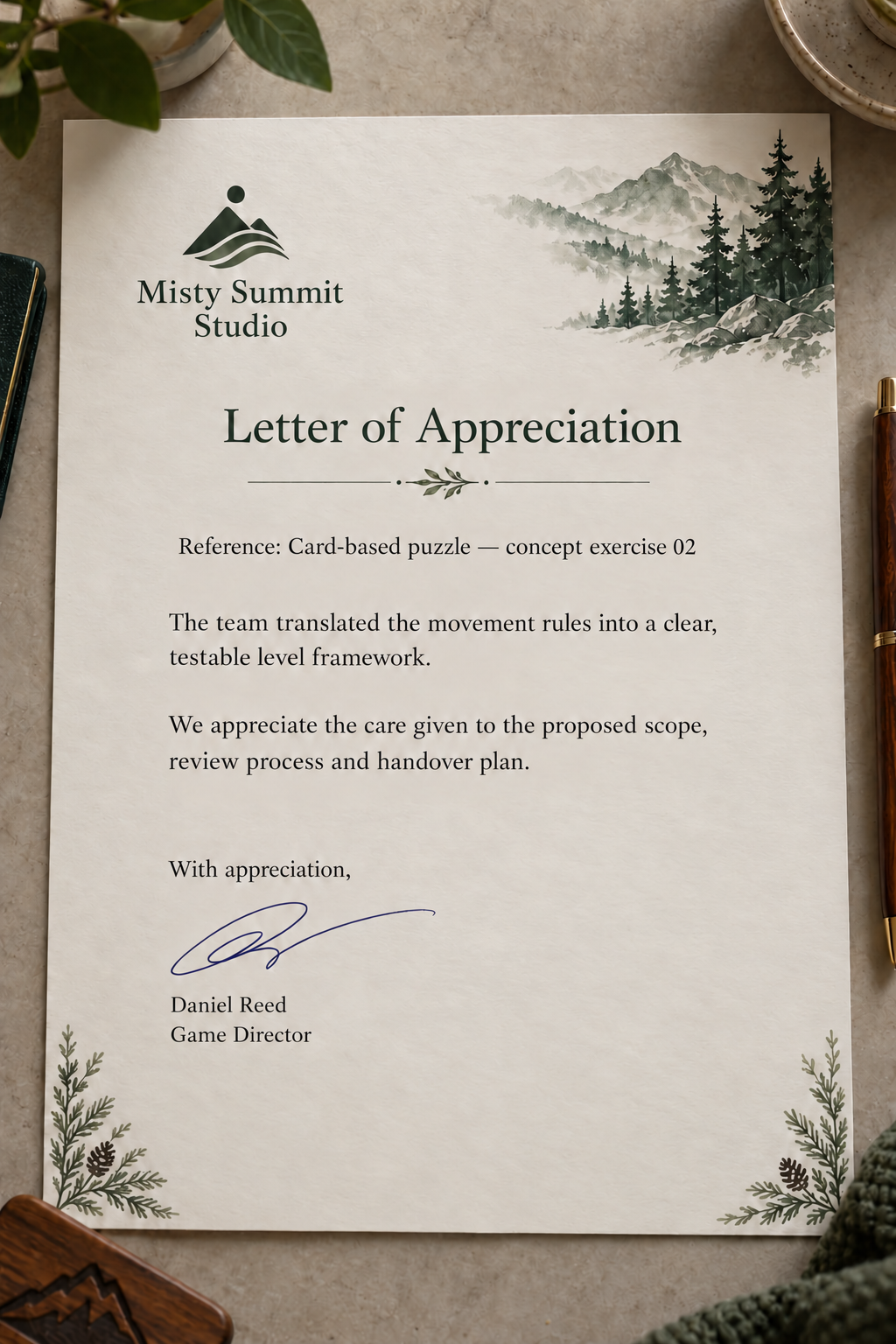
Client testimonial
“What stood out was how clearly the team turned movement rules into playable levels. We could review a mechanic, test the edge cases and agree on the next iteration without long explanations. The process stayed focused on making each puzzle feel fair and satisfying.”

What we learned
A level editor is a production investment: it helps designers test combinations without asking engineers to modify every course.
A limited action vocabulary can support substantial depth when every consequence is dependable. The content challenge is to introduce combinations that ask new questions without making familiar rules behave differently from level to level.
Build a similar game
Tell us about your audience, target platforms, core gameplay and business goals. We will help define the scope and estimate the work.